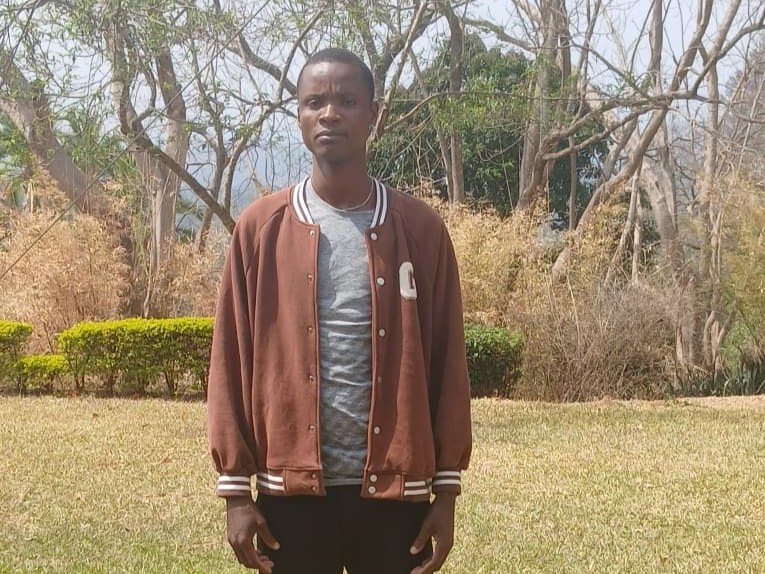
Shabani Veri Kgwedi’s journey from a troubled schoolboy to a University of Malawi student is a powerful account of second chances, personal transformation and the possibility of rehabilitation behind prison walls.
Kgwedi was selected in 2026 to pursue a Bachelor of Social Science in Gender Studies at the University of Malawi (UNIMA)—an achievement that would have seemed almost impossible when he first entered prison.
His story began in Mlenga 2 Village under Traditional Authority Mwambo in Zomba, where he was born into a family of eight children. His family background is itself marked by migration, with his paternal grandmother and father having originated from South Africa before eventually settling in Malawi.
Kgwedi’s academic potential first became evident at Namiwawa Primary School where he performed well enough to earn selection to secondary school, scoring four As and a D in Mathematics.
But academic ability did not automatically translate into good choices.
At Masongola Secondary School, Kgwedi says he was advised to associate with mathematically gifted students. In doing so, however, he says he became increasingly influenced by some of their mischievous behaviour.
What followed was a dramatic departure from the promising academic path that had opened before him.
He became, by his own description, a “perpetual offender”, repeatedly being caught out of bounds. Eventually, on November 11, 2011, he was indefinitely suspended from the school.
The suspension marked the beginning of a wandering life.
Still very young, Kgwedi moved into the world of employment, working for companies in Blantyre before venturing into the butchery business.
His search for opportunities subsequently took him beyond Malawi to South Africa, Zimbabwe and Mozambique, where he became involved in gold mining.
But life away from home proved difficult.
Kgwedi eventually became seriously ill with tuberculosis and was forced to return to Malawi. On January 27, 2022, friends accompanied him back home. He was quarantined at Queen Elizabeth Central Hospital in Blantyre before being transferred to Zomba Central Hospital.
It was after his return that another chapter of his life unfolded.
Kgwedi says a family dispute over whether a male member of the family should build a house at their home escalated into a confrontation between two groups of biological brothers.
On the last Friday of April 2022, the dispute turned violent. In the course of the confrontation, Kgwedi says his mother was injured on the right arm while attempting to intervene and calm the situation, while one of his brothers also sustained injuries.
The incident attracted police attention and ultimately ended up before the courts.
On June 24, 2022, Kgwedi and others were convicted of acts intended to cause grievous harm and received consecutive sentences of seven and six years.
For Kgwedi, however, prison was not going to mark the end of his story.
Instead, he decided that the period behind bars would become an opportunity for transformation.
“When I began my life in this abyss, I thought it worthwhile to change my mindset,” he says.
Drawing inspiration from his faith, including the Biblical passages Revelation 3:19 and Proverbs 28:13, Kgwedi embarked on what he describes as a process of spiritual and personal transformation.
His ambition was not simply to secure an early release. He wanted to become a different person and education became central to that transformation.
Inside prison, Kgwedi enrolled in Form Three. In 2023, he sat for the Malawi School Certificate of Education (MSCE) examinations and emerged third among inmates who sat for the examinations nationally with 22 points.
The achievement opened another door. The Malawi Prison Service’s education programme gave him an opportunity to work as a teacher, allowing him to use his own educational journey to assist others within the correctional environment.
But Kgwedi was not satisfied with his first examination result. Two years later, he decided to sit for the examinations again. This time, he improved his score dramatically, obtaining 16 points and emerging as the best-performing inmate nationally.
Then came the achievement that has transformed his story from one of incarceration to one of academic possibility.
In 2026, Kgwedi was selected to study at the University of Malawi, pursuing a Bachelor of Social Science in Gender Studies.
Today, a man whose formal education was once interrupted by indefinite suspension is sitting in a university classroom, pursuing one of Malawi’s most coveted academic opportunities.
His journey presents prison not merely as a place of punishment, but also as an environment where reform, education and rehabilitation can change the trajectory of a person’s life.
Kgwedi’s story does not erase the circumstances that brought him into conflict with the law. Rather, it demonstrates that a person’s past does not necessarily have to determine his future.
Kgwedi now pleads with members of the public to assist him procure a laptop and a smart phone for academic purposes.
From a schoolboy whose promising education was derailed by poor choices, to a prisoner who rediscovered education, to a teacher inside the correctional system, and finally to a university student, Kgwedi has travelled a remarkable distance.
His transformation also provides a human face to the idea that correctional institutions can serve a purpose beyond confinement.
For Kgwedi, prison became an unlikely classroom, and from that classroom came a second chance.