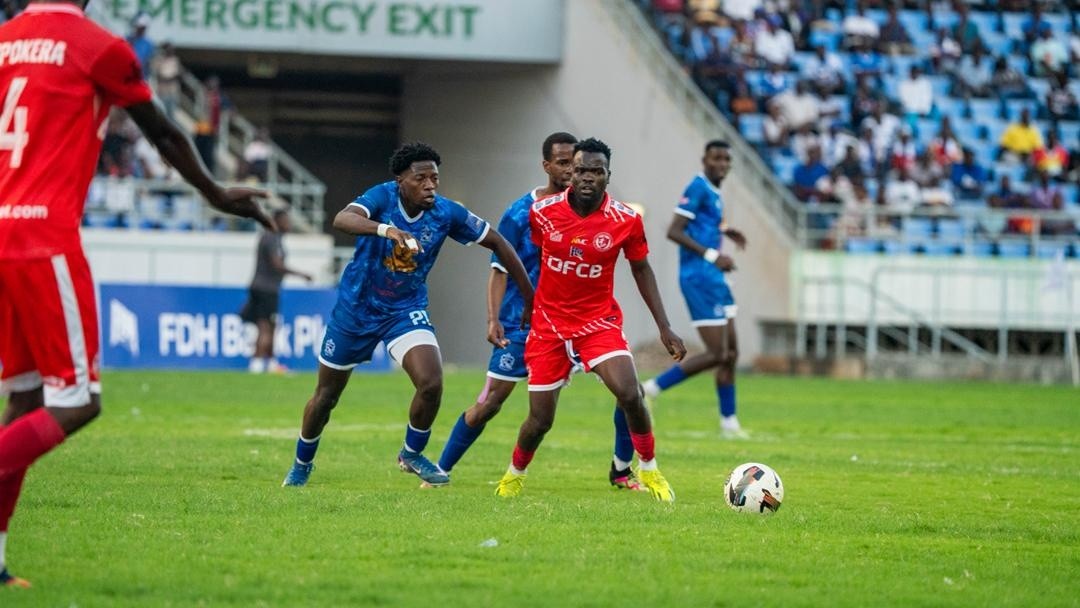
Relief swept across the red half of football fans on Sunday 10th May 2026 as FCB Nyasa Big Bullets finally halted their miserable run against archrivals Mighty Wanderers with a hard-fought 2-1 derby victory in Lilongwe.
For Bullets fans, it was more than just a win: it was a statement of resilience after four consecutive defeats at the hands of Wanderers, including elimination in the FDH Bank Cup semifinal and a painful 1-0 loss in the 2026 NBS Bank Charity Shield.
More importantly, the result may have eased mounting pressure on Bullets Coach Gilbert Chirwa, whose position was increasingly coming under scrutiny after repeated setbacks against their fiercest rivals.
Another defeat would almost certainly have intensified dissatisfaction among the Bullets faithful and placed Chirwa’s tenure in serious jeopardy.
Instead, Bullets produced one of their most tactically disciplined and emotionally committed performances in recent meetings against Wanderers.
After the match, Chirwa revealed that Bullets had undertaken serious introspection ahead of the derby.
“We had our postmortem where we analysed our shortfalls and I encouraged the boys to be vigilant today,” said Chirwa.
That vigilance was evident from the opening whistle.
For perhaps the first time in recent derbies, Bullets matched Wanderers in intensity, aggression and work rate.
They pressed relentlessly, contested every second ball and denied Wanderers the rhythm that has often made them dominant in previous encounters.
At the heart of that control were Paul Master and Yankho Singo, who successfully neutralised Wanderers’ energetic midfield engine.
Daniel Kudonto’s usual hustle and bustle was contained, while Isaac Kaliati struggled to influence the game and repeatedly misplaced passes under pressure.
Wanderers also appeared unbalanced in midfield with Lameck Mithi struggling to provide the attacking potency required in such a high-intensity contest, exposing Wanderers to transitions and limiting Blessings Singini’s ability to drive forward effectively from midfield.
The game cried out for the combative presence of Felix Zulu as a holding midfielder to allow Singini greater freedom as a box-to-box number eight.
It was, therefore, unsurprising when Wanderers coach McDonald Nginde Mtetemela eventually withdrew Mithi in search of greater balance.
However, the decisive tactical weakness for Wanderers lay on the right side of defence.
For the first time in several matches, Wanderers adopted a 4-5-1 formation, with Sama Thierry Tanjong operating as a lone striker.
The apparent intention was to crowd midfield spaces and minimise the influence of Bullets’ dangerous wide players, particularly Clever Kalambo and Gastin Phodo.
But the plan unravelled largely because of Masiya Manda’s struggles at right back.
Manda endured a torrid afternoon and repeatedly found himself caught out of position against the pace and movement of Kalambo.
His positional indiscipline eventually proved costly as Bullets took the lead in the 24th minute after Aaron Chilipa exploited acres of space down the flank before delivering a dangerous cross towards Ephraim Kondowe, who was brought down inside the box.
Referee Kanjere had little hesitation in awarding a penalty.
The sequence exposed Wanderers’ structural vulnerability on the right side, with Manda failing to recover his defensive position in time.
Mtetemela reacted swiftly. Just two minutes after the goal, Manda was substituted for Promise Kamwendo, allowing Stanley Sanudi to return to his natural right-back role as Wanderers reverted to their more familiar 3-5-2 system.
The tactical reshuffle improved Wanderers in the second half, particularly through Gaddie Chirwa, whose movement and physicality began to trouble Bullets.
However, Wanderers arguably failed to maximise Chirwa’s effectiveness earlier in the game due to constant positional rotations involving Kaliati and Kamwendo.
Gaddie Chirwa looked most dangerous when stationed as a traditional right winger where he could provide width and deliver crosses into the penalty area.
In the second half, he became a major attacking outlet.
Aaron Chilipa struggled to cope with his raw energy and direct running, while Wanderers repeatedly threatened from aerial deliveries.
On another day, Wanderers might have rescued the match after striking the crossbar three times during sustained spells of pressure.
But the turning point came with Chirwa’s red card following an altercation with Gastin Phodo.
The dismissal robbed Wanderers of their most dangerous attacking weapon at a crucial stage of the contest and significantly reduced their offensive threat as Bullets regained control in the closing moments.
For Bullets, the victory may yet prove psychologically transformative.
Beyond the three points and derby bragging rights, the performance suggested a side rediscovering its identity – aggressive, organised and emotionally invested in the occasion.
After weeks of frustration and growing uncertainty, Bullets supporters will now hope this victory signals not merely the end of a losing streak, but the beginning of a return to their traditional dominance in Malawian football.